WinShark payment methods
 Available in US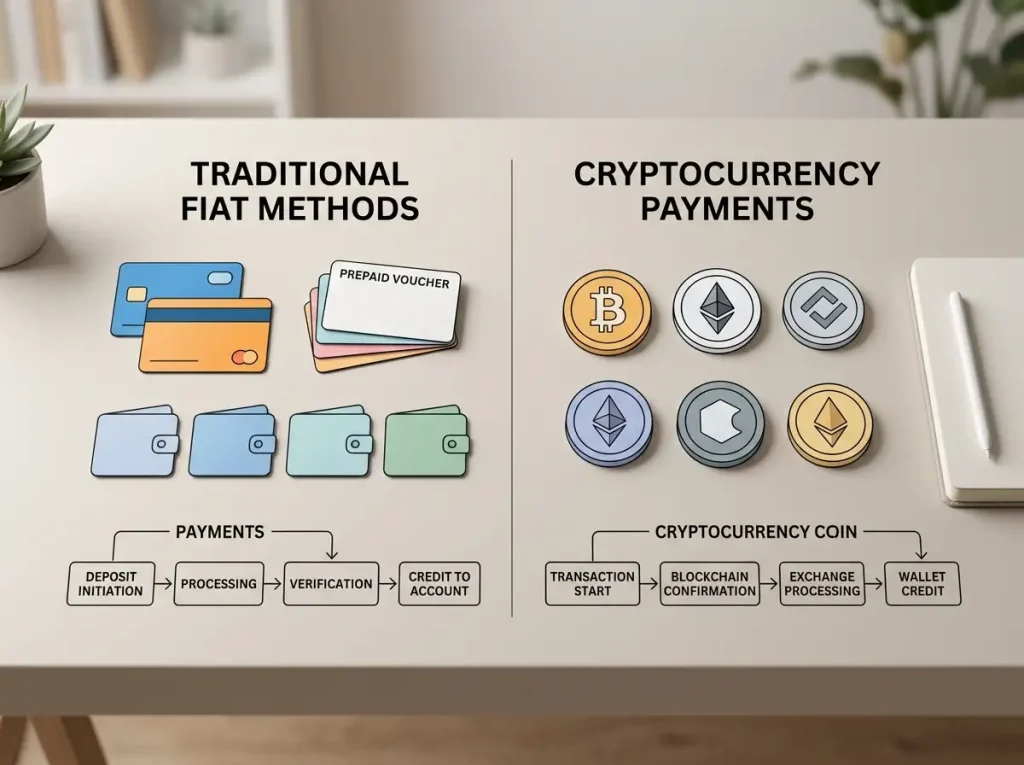
WinShark uses a hybrid payment model, combining conventional fiat rails with a broad group of cryptocurrencies. The useful way to compare those options is by function: cards and wallets move fiat value, prepaid methods separate gambling spend from a main bank balance, bank routes trade speed for familiarity, and crypto adds network costs, price movement and irreversible transfers. The payment list is broad, but individual methods can vary by country and account context.
Table of Contents
- The payment picture changes once money moves back out
- Crypto rails add asset movement and transaction finality
- Casino fees and payment-rail costs are different line items
- The method mix covers cards wallets prepaid rails and crypto
- Fiat rails remove crypto price exposure but still have provider terms
- Common questions about WinShark payments
- Payment choice is broad across fiat and crypto rails
The payment picture changes once money moves back out
A deposit-method list is only half of the payment story. WinShark also applies cashout limits and processing windows, and identity or payment-method checks can affect a withdrawal. That means the route used to fund an account should be read alongside the rules that govern money leaving it.
The detailed limits belong on the WinShark withdrawals page, where transaction, daily and monthly caps can be compared with the listed processing windows. On the payments overview, the important point is structural: a method that is easy to fund with is not automatically the fastest, cheapest or least restrictive route for cashing out.
- Identify whether the route is fiat or crypto.
- Separate any casino-side fee from provider or network costs.
- Check how withdrawals are processed for the account rather than assuming the deposit path determines the cashout experience.
- Allow for verification checks before treating a listed transfer window as an arrival time.
This sequence keeps three different constraints from being blended together: the payment instrument, the casino’s account rules and the external payment network. Each can add its own friction.
Crypto rails add asset movement and transaction finality
The current WinShark crypto mix includes Bitcoin, Ethereum, Litecoin, Bitcoin Cash, Tether and Cardano. Additional listings include USDC, Dogecoin, Solana, XRP, TRON and Toncoin. This gives the payment catalogue both volatile assets and stablecoin-style options, but the existence of a coin in the catalogue does not establish a particular blockchain network fee or exchange rate.
Crypto transfers add two risks that do not arise in the same way with an ordinary fiat balance. First, the AUD value of a volatile asset can change while it is held. Second, blockchain transfers may be irreversible once sent. Network fees can also change independently of any fee charged by the casino.
- BTC, ETH, LTC and BCH: crypto assets whose market value can move against AUD.
- USDT and USDC: stablecoin-style assets designed to track a reference value, while still carrying network and transfer risks.
- ADA, DOGE, SOL, XRP, TRX and TON: additional assets appearing in current WinShark payment listings.
The practical cost of a crypto transfer therefore has several components. A user can enter a position at one AUD value, pay an inbound network or service cost, experience a price move, and later pay another cost to move the asset out. The Crypto value check on the home page models those inputs as user scenarios without treating them as WinShark charges or as a market forecast.
For comparison work, it is useful to keep the asset and the network conceptually separate. A coin name tells you which asset is being transferred; it does not, by itself, tell you the exact route, confirmation time or fee for a particular transaction. Those values can depend on the network, wallet and provider selected at the time.
Casino fees and payment-rail costs are different line items
WinShark lists no casino deposit or withdrawal fee. That does not mean every transfer is cost-free. A card issuer, e-wallet, bank, exchange or blockchain network can apply its own charge, spread or conversion cost outside the casino’s fee schedule.
| Payment group | Known WinShark examples | Cost factor to keep separate |
|---|---|---|
| Cards and prepaid | Mastercard, Paysafecard, CASHlib, Neosurf | Issuer, prepaid-provider or currency-conversion charges can sit outside the casino fee line. |
| Digital wallets | Skrill, Revolut, MiFinity, Neteller | Wallet funding, withdrawal or FX pricing can differ by provider and account. |
| Bank and transfer rails | Bank transfer, Rapid Transfer, BLIK | Bank processing and conversion terms belong to the payment provider. |
| Cryptocurrency | BTC, ETH, LTC, BCH, USDT, ADA and additional listed assets | Network fees, exchange spreads, price movement and transfer irreversibility can affect the end-to-end result. |
The distinction is important when comparing methods because a “no casino fee” label answers only one part of the question. A method can still cost money at another point in the chain. Conversely, a method with a visible external charge may offer a different processing pattern or account fit. The useful comparison is the full route from source of funds to destination, not just the casino’s own fee column.
Crypto deserves extra care because the amount received can differ from the AUD value expected even when the nominal number of coins is unchanged. Market movement and network cost can both alter the effective value. Fiat methods remove the crypto-price component, although provider fees and settlement timing can still apply.
The method mix covers cards wallets prepaid rails and crypto
WinShark’s fiat payment catalogue includes Mastercard, Rapid Transfer, Paysafecard, Skrill, Revolut, CASHlib, bank transfer, MiFinity, Neteller, Neosurf and BLIK. The list spans several payment families rather than relying on a single card-plus-bank setup.
That diversity makes category-level comparison more useful than a flat list of brand names. A prepaid voucher behaves differently from an e-wallet; a bank transfer behaves differently from a card; and a crypto transfer introduces an entirely different settlement model. Method availability can also vary by country, so the presence of a name in the wider payment catalogue should not be treated as a promise that it appears for every account.
| Category | WinShark payment methods | Typical role |
|---|---|---|
| Card | Mastercard | Direct fiat payment through a card account. |
| E-wallet / digital account | Skrill, Revolut, MiFinity, Neteller | Separates the casino transaction from the primary bank account and can add its own balance or FX rules. |
| Prepaid | Paysafecard, CASHlib, Neosurf | Uses prepaid value rather than a conventional bank transfer at the point of deposit. |
| Bank / transfer | Bank transfer, Rapid Transfer, BLIK | Moves fiat through banking or account-to-account rails. |
| Crypto | BTC, ETH, LTC, BCH, USDT, ADA, USDC, DOGE, SOL, XRP, TRX, TON | Moves digital assets through blockchain or crypto-payment infrastructure. |
A broad method mix can make account funding more flexible, but it does not remove the need to compare the withdrawal path. Some payment systems have different inbound and outbound capabilities, and the casino’s verification process can become relevant when money is withdrawn. For that reason, a method should be judged by the whole transaction cycle rather than by deposit convenience alone.
Fiat rails remove crypto price exposure but still have provider terms
Fiat methods are easier to reason about in one important respect: an A$ value does not change because a cryptocurrency price moved. That makes the payment amount itself more stable during the transfer. The remaining variables are provider fees, currency conversion, processing windows, funding-source rules and the casino’s account checks.
Different fiat categories solve different problems. An e-wallet can create separation between a bank account and the casino transaction. A prepaid method can cap the amount loaded in advance. A bank route can suit someone who prefers account-to-account transfers. A card can be familiar and direct. None of those characteristics automatically makes one category superior; they simply expose the user to different operational constraints.
- Check whether the method appears for the account before relying on a wider global list.
- Read provider charges separately from the casino’s own fee policy.
- Do not assume that a deposit method guarantees an identical withdrawal route.
- Treat a stated processing window as a policy range rather than a promise of arrival time.
Payment selection also interacts with the rest of the product. Someone focused on the games catalogue may care primarily about straightforward budgeting, while someone studying the loyalty programme should still keep payment costs separate from any rewards or cashback mechanics. A payment rail changes how money moves; it does not change the underlying gambling risk.
Common questions about WinShark payments
Does WinShark support both fiat and cryptocurrency?
Yes. Current payment listings include conventional methods such as Mastercard, wallets, prepaid options and bank transfer, alongside cryptocurrencies including BTC, ETH, LTC, BCH, USDT and ADA.
Does WinShark charge deposit or withdrawal fees?
WinShark lists no casino deposit or withdrawal fee. Payment providers, exchanges or blockchain networks can still add their own costs.
Which crypto assets appear in WinShark payment listings?
The current list includes BTC, ETH, LTC, BCH, USDT and ADA, with additional listings for USDC, DOGE, SOL, XRP, TRX and TON.
Are payment methods the same in every country?
Payment methods can vary by country and account context; the general catalogue does not guarantee availability for every account.
Where are WinShark withdrawal limits explained?
The dedicated withdrawals guide covers the listed transaction, daily and monthly caps, processing windows, fees and verification factors.
Payment choice is broad across fiat and crypto rails
WinShark’s payment catalogue spans cards, digital wallets, prepaid methods, bank-style transfers and a sizeable crypto list. The most useful distinction is not the number of logos but the type of cost each rail introduces. Fiat avoids crypto price movement but can still carry provider or conversion charges. Crypto adds market movement, network costs and irreversible transfers. In both cases, the separate cashout rules and verification process matter when assessing the full payment cycle.